Georgia Financial Literacy Standards and Policy Ranking

The Georgia Financial Educators Council (GFEC) is the state advocacy chapter of the National Financial Educators Council (NFEC). Our role is to advance policy, standards alignment, and statewide action to ensure that Georgia students graduate prepared to manage real-world financial decisions.

The NFEC conducts national research and develops academic standards. GFEC translates that research into policy advocacy specific to Georgia. Our shared mission is to ensure that all learners graduate prepared to navigate real-world financial decisions by elevating financial education to the same level of quality, accountability, and instructional integrity as other required core academic subjects.

Georgia Financial Education Standards Alignment: A State-Level Policy Assessment

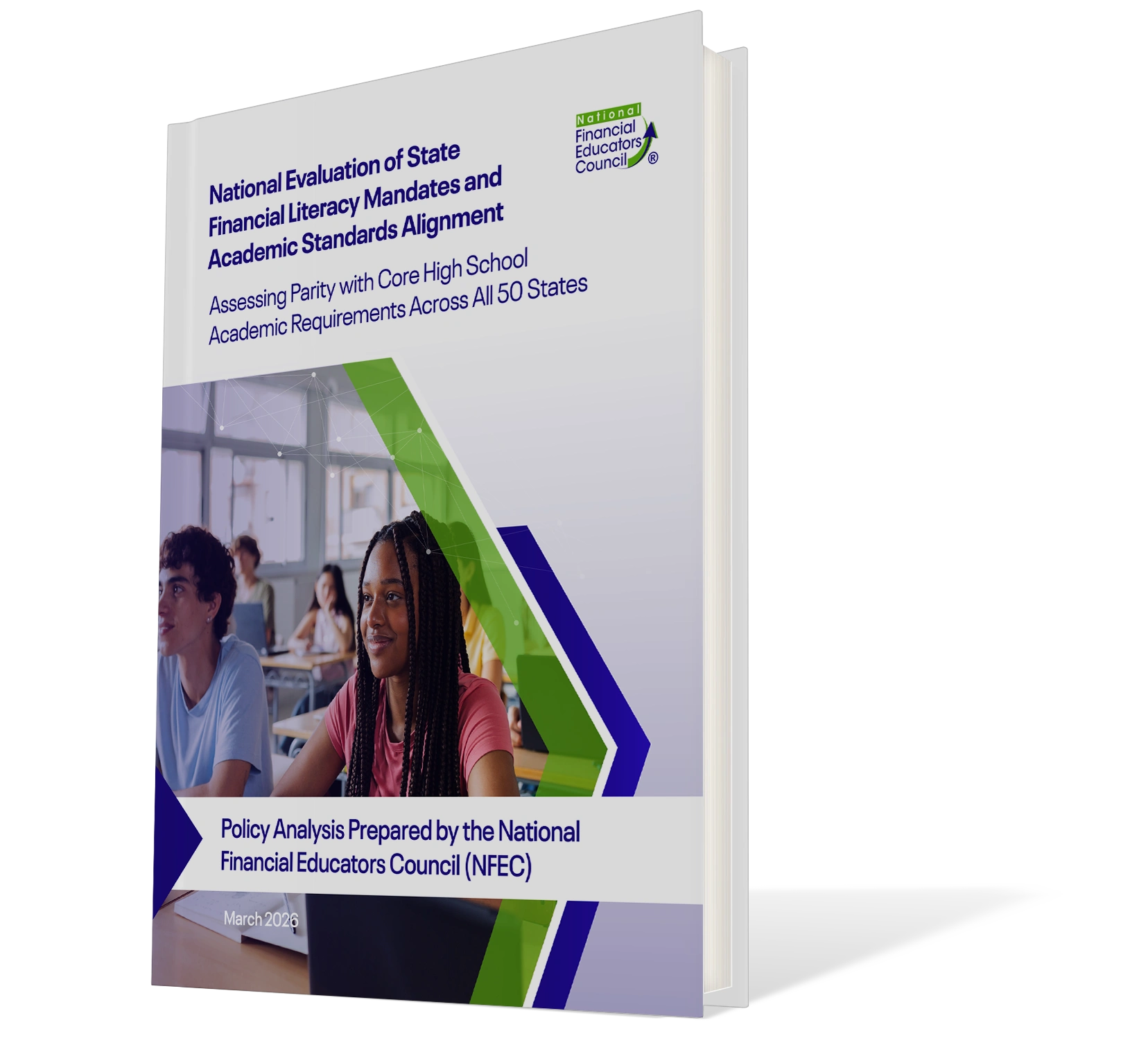
Research from the NFEC indicates that Georgia’s approach to financial education does not meet the baseline academic standards generally required of core high school subjects. Using a standardized 12-criterion framework applied uniformly across all 50 states, the NFEC assessed whether state-led financial education policies align with fundamental expectations in areas such as instructional rigor, governance structures, curriculum strength, teacher readiness, assessment systems, and sustained program support.

Within this framework, Georgia received an overall alignment score of 4.2 out of 100 and was categorized as Failing. Of the 12 criteria evaluated, 11 were rated Failing, one fell into the Below Par category, and none reached an At Par level. These findings point to a significant gap in key policy elements typically present in core academic disciplines, suggesting that Georgia’s financial education system lacks the necessary infrastructure to provide instruction that is consistent, rigorous, and accountable at a level comparable to mathematics, science, and English/language arts.

Georgia Financial Education Assessment

GFEC’s Advocacy Focus in Georgia

GFEC works to ensure that financial education is treated as a core academic subject rather than optional enrichment. Our advocacy is organized to advance priorities that align Georgia’s policy environment with established academic expectations.
Research & Policy Guidance

GFEC promotes financial education policies aligned with core academic standards, emphasizing clear outcomes, educator preparedness, and accountability. Grounded in national research, GFEC works with educators, community leaders, and policymakers to identify gaps, evaluate legislation, and support scalable, standards-aligned implementation.

Standards for Financial Educators and Learners

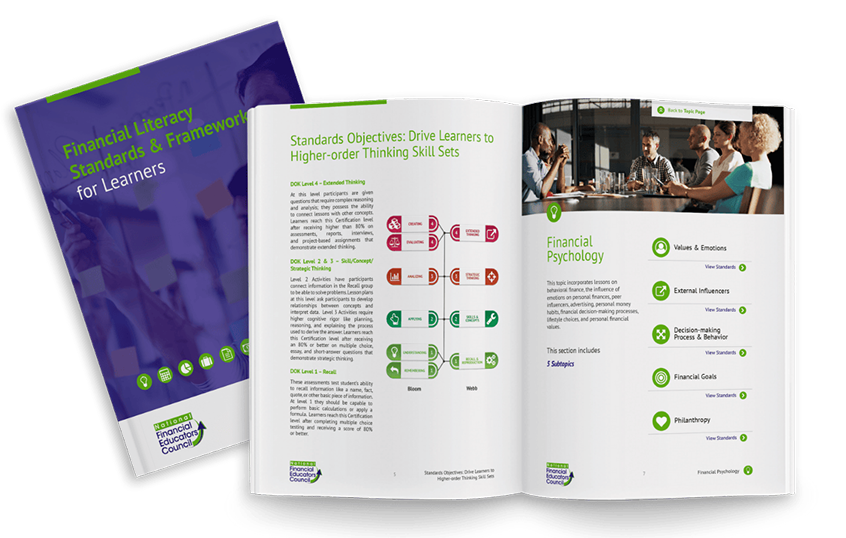
GFEC supports the adoption of comprehensive learner outcome standards and educator competency frameworks to strengthen instructional quality statewide. By providing clear benchmarks for what students should know and be able to do – and what educators must demonstrate to teach effectively – GFEC helps establish consistent expectations that support long-term financial capability development.

Closing Statement

Georgia’s students deserve more than exposure to financial concepts; they deserve real preparation for the financial decisions that shape adulthood. These findings reveal a clear opportunity to strengthen financial education by aligning it with the rigor and accountability applied to other core subjects.

By advancing standards-based reform and investing in quality implementation, Georgia can ensure that every student graduates financially prepared for life beyond high school. Meaningful progress requires collective action from educators, families, policymakers, and community leaders – working together to make financial education a foundational part of a future-ready education system.

National Financial Educators Council

Georgia Code § 20-2-149.4

SB 220 Signed Legislation PDF

Georgia Social Studies Personal Finance Standards PDF

NFEC’s national and state advisory board

National Evaluation of State Financial Literacy Mandates and Academic Standards Alignment

State-Mandated Financial Literacy Standards: A Comprehensive National Review

What states require financial education in high school

Certified educator in personal finance

Teaching elementary students financial literacy

Financial Literacy Standards in Georgia

As of the 2024-25 school year, Georgia requires students to complete at least a half-credit course in personal financial literacy during grades 11 or 12 for high school graduation. Enacted through Senate Bill 220 (2022), codified in Georgia Code § 20-2-149.4, the course may count toward mathematics, social studies, or elective credit. Content is based on standards adopted by the State Board of Education, covering topics like budgeting, credit, investing, taxes, insurance, and financial decision-making. Source.

While Georgia’s early mandate guarantees exposure in upper grades, the framework has limitations compared to core subjects. There is no dedicated state funding for curriculum, teacher training, or delivery; no mandated professional development or instructor qualifications; and no statewide accountability for student outcomes (e.g., assessments or reporting). Districts rely on voluntary resources, risking inconsistent quality and depth. The absence of a full K-12 progressive sequence further limits foundational learning in earlier grades. Source.

The American Public Education Foundation (APEF) grades each U.S. state based on its financial literacy standards as part of the foundation’s ongoing initiative, The Nation’s Report Card on Financial Literacy. As of 2022, the Peach State received a grade of “B” for financial education. The significant accomplishments Georgia made to earn this grade include having a required high school course with financial literacy standards; requiring high schools to offer financial education as an elective; and putting financial education standards in place for grades K-8.

In 2013 with House Bill No. 2662, the Georgia legislature amended the state’s Education Code such that “The Georgia essential knowledge and skills…shall include instruction in personal financial literacy…in one or more courses offered for high school graduation.” In 2021, the Georgia General Assembly passed Senate Bill 1063, which created a one-half credit high school course titled “Personal Financial Literacy and Economics,” of which two-thirds of the instruction is spent on personal finance topics.